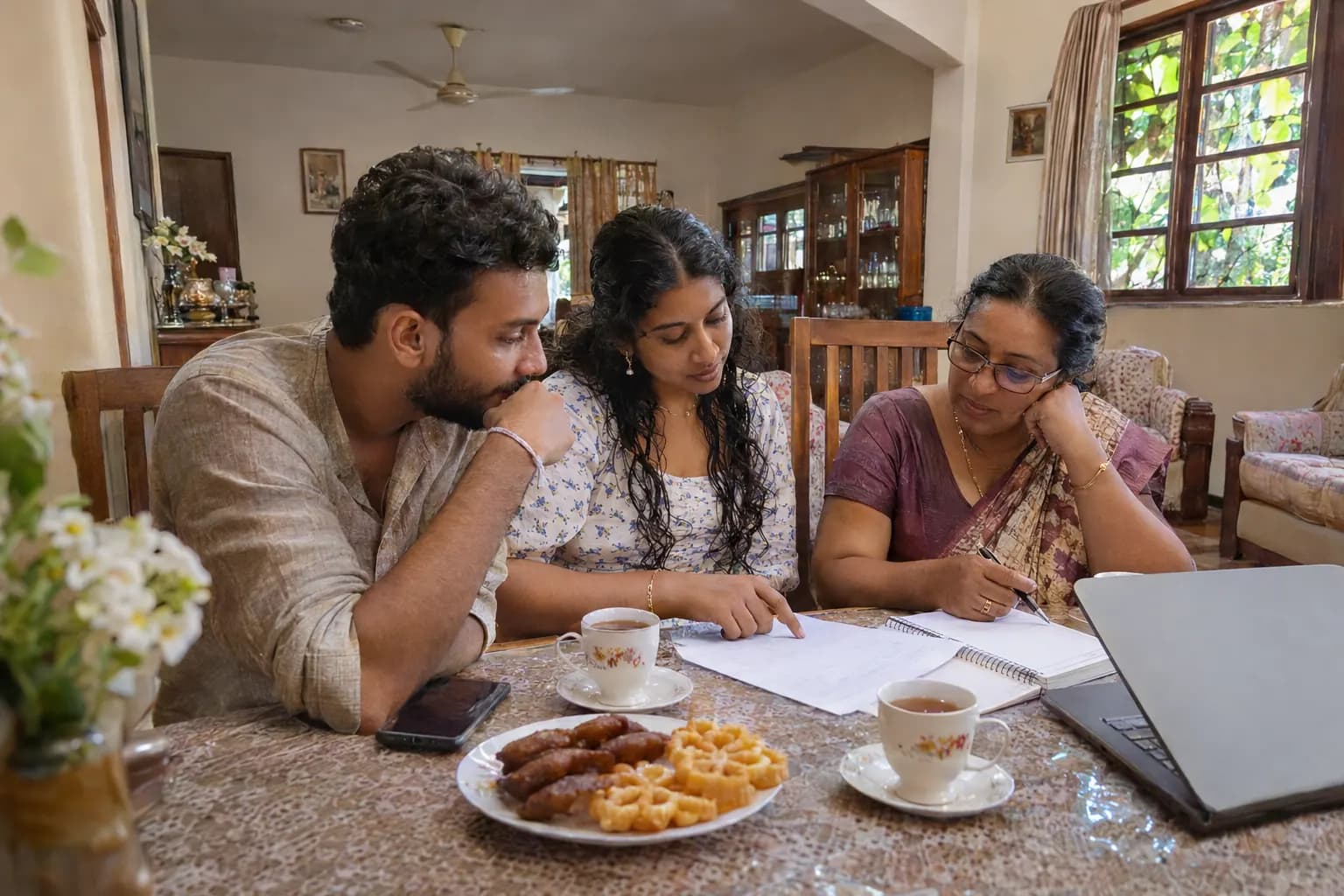
Build a Sri Lankan wedding guest list by household, not by person. Give every family one row with a head count, mark it bride's side, groom's side or both, and note which events it is invited to. Agree the total number of guests with both families first, then let each side fill and trim its own share.
This guide covers who usually invites whom, how the wedding and the homecoming split the list, a worked example with numbers, and where the liquor count fits. If you would rather keep the list somewhere that also sends invitations and collects replies, our guest list and seating planner is built around the same method.
Start with households, not names
A Sri Lankan invitation goes to a family. "Mr. and Mrs. Perera and family" is one invitation, one reply and one row on your list, even if five people come. Counting this way keeps the list short enough to manage and matches how guests will reply.
- One row, one invitation. Write the name exactly as it should appear on the invitation, then the number of people it covers.
- Split households that live apart. A married son with his own home usually expects his own invitation, even if his parents are already on the list.
- Write the head count you are inviting. If you are inviting the parents but not the grown-up children, the row says 2, and the invitation should make that clear.
- Keep a phone number on every row. You will need it to send the invitation and to chase a reply.
Bride's side and groom's side
Each family usually builds its own half of the list, and the couple adds their own friends. Mark every row with a side so each family can check its own names without reading the whole list, and so you can see at a glance whether the split matches what was agreed.
There is no rule that the two sides must be equal. The split often follows who is hosting which event, how large each family is, and how many of the parents' friends and colleagues are expected. What matters is that both families agree the number before anyone starts inviting, because a list is far easier to grow than to cut.
Mutual friends, the couple's office and people both families know can sit under "both", so they are not counted twice or argued over.
Who invites whom
Knowing who invites each circle tells you who owns that part of the list, and who should deliver the invitation personally where that is expected.
| Circle | Usually invited by | Worth knowing |
|---|---|---|
| Close relatives | The parents on each side | Elders often expect a personal visit or a call as well as the invitation. |
| Parents' friends and neighbours | The parents | Often the largest and hardest circle to trim. Agree a share for it early. |
| Parents' colleagues | The parent who works there | Decide whether it is the whole office or a few people, and keep it consistent. |
| The couple's friends | The couple | Decide on partners and plus-ones once, for everyone. |
| The couple's colleagues | The couple | Usually the first circle to shrink if the venue fills up. |
| Clergy, monks or the officiant | The family, in person | Invite them personally and with respect, following the custom of your faith. |
How the two events split the list
Many Sri Lankan weddings have more than one event: the wedding day itself, with the Poruwa or the church service and the reception, and the homecoming a few days later. Traditionally the groom's family hosts the homecoming, so its list often leans towards the groom's side, and it is often smaller.
Give every row a column for each event and tick the ones that household is invited to. Some families are invited to both, some to only one. That one habit gives you a separate head count for each venue and stops the homecoming numbers being guessed from the wedding list. Our article on the homecoming ceremony explains the day itself.
Some families also keep the Poruwa or the church service to close family, with the wider list joining for the reception. If you do that, give the ceremony its own column too.
A worked example with numbers
Here is a made-up list for an imaginary couple, Nimesh and Dilhani, whose reception hall holds 300 guests. The numbers are invented to show the method; they are not a guide to what a typical Sri Lankan wedding looks like.
| Circle | Side | Households | Heads | Wedding | Homecoming |
|---|---|---|---|---|---|
| Bride's close family | Bride | 18 | 62 | 62 | 40 |
| Groom's close family | Groom | 20 | 68 | 68 | 68 |
| Bride's parents' friends and neighbours | Bride | 22 | 50 | 50 | 10 |
| Groom's parents' friends and neighbours | Groom | 20 | 46 | 46 | 46 |
| The couple's friends | Both | 24 | 36 | 36 | 20 |
| The couple's colleagues | Both | 15 | 18 | 18 | 6 |
| Total | 119 | 280 | 280 | 190 |
What the example shows:
- 119 invitations, not 280. Counting households means sending 119 invitations and chasing 119 replies, even though 280 people are invited.
- Room left in the hall. 280 heads in a 300-seat hall leaves space for the guests who are always added late, such as a relative arriving from abroad.
- Two different venue numbers. The homecoming has 190 heads, because many of the bride's parents' friends come only to the wedding.
- A clear place to cut. If the hall were smaller, each side can see exactly how many heads its own circles add.
Trimming the list without a family argument
- Agree the total before the names. A number agreed by both families is easier to keep than a list that has already been promised.
- Each side trims its own rows. Nobody cuts names from the other family's half.
- Make one rule per circle. "Colleagues without partners" or "no children except close family" is fair because it applies to everyone.
- Keep a waiting list. When someone declines, the next household on the list can be invited in time.
Turning the list into real numbers
The list tells you who is invited. The replies tell you who is coming. Ask every household to reply with how many of them will attend, set a date for replies a few weeks before the caterer needs final numbers, and follow up the ones who have not answered. Our article on whether Sri Lankan guests really RSVP covers how to chase replies without phoning every family.
Where the liquor count fits
If you are serving drinks, the guest list is the best place to start the liquor count. Against each household, note how many drink beer, wine or spirits, and treat everyone else as a non-drinker. Early on, size the bar from everyone invited; once replies are in, switch to the guests who confirmed.
In the made-up example above, suppose 70 of the 280 wedding guests drink beer, 30 drink wine and 60 drink spirits. At one bottle of beer per beer drinker, a bottle of wine for every five wine drinkers and a bottle of spirits for every four spirits drinkers, that is 70 bottles of beer, 6 of wine and 15 of spirits. Adjust those ratios to your crowd and agree the final order with your venue or supplier.
Seating starts from the same list
Once the replies are in, the same households become your table plan. Seat families together, keep each side's elders near the front, and split a large family across two neighbouring tables rather than leaving one person on their own. The guest list, seating and planning features page shows how the table plan, the printed seating chart and the name cards all come from one list.
Keep the whole list in one place with INVITATION.LK
INVITATION.LK keeps the list the way this guide builds it, and then sends it, collects replies and seats it.
- Households on one link. Invite type To You, To You Both or To Your Family, with the number of guests.
- Sides and groups. Bride Side, Groom Side or Both, plus groups such as Family, Office or your own.
- Import from Excel or CSV. Fill in the template and upload up to 2,000 rows per file.
- Replies with head counts. Guests answer Attending or Not attending and confirm how many are coming.
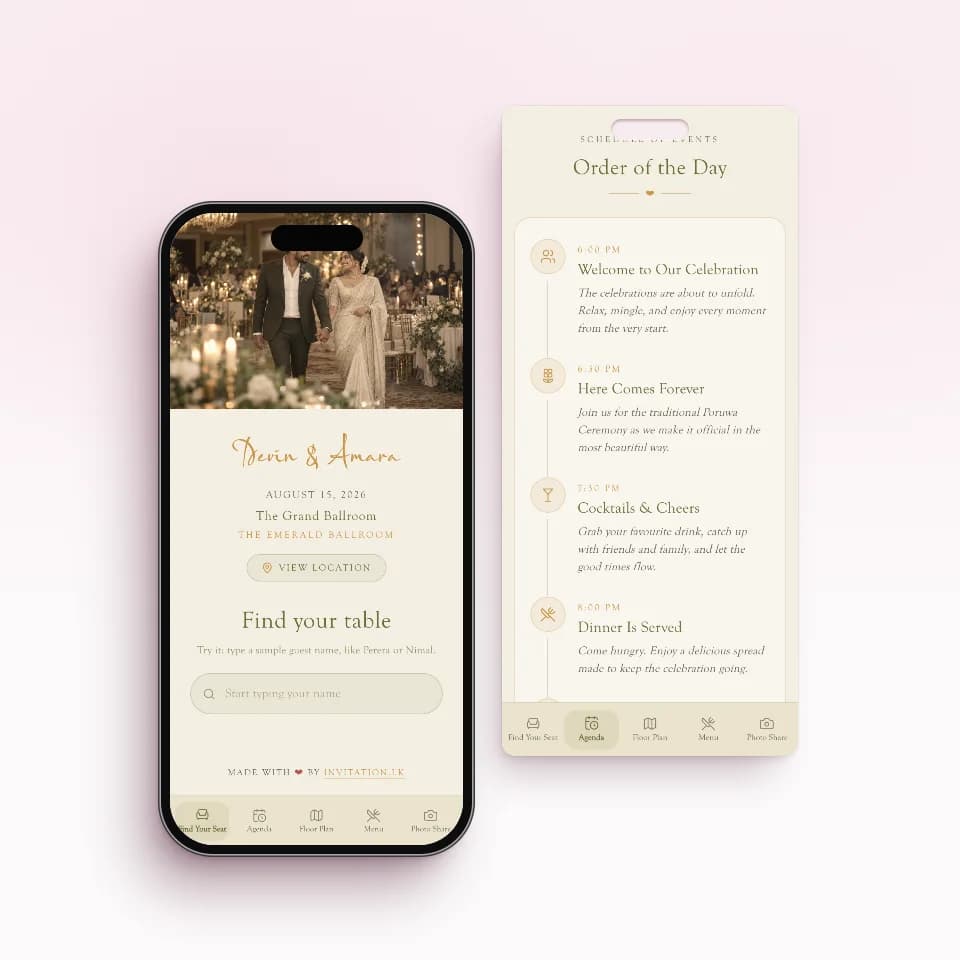
- Tables guests can search. Publish the seating plan and guests find their own table on the invitation.
- A liquor planner. Bottles of beer, wine and spirits worked out from invited or confirmed guests.
Essential is Rs. 5,000 for one ready-made invitation, Complete is Rs. 10,000 for two (the wedding and the homecoming, for example), and Signature Custom is Rs. 20,000 for a design made just for you. You pay once, only when you publish, and every paid plan includes unlimited guest links.
Compare the plans and what each one includes, or browse the wedding invitation designs first.