The best wedding card design for a Sri Lankan wedding starts with the ceremony and then your taste. Kandyan ivory, maroon and gold suit a Poruwa. Florals and chapel doors suit a church. Temple gold and kumkum suit a kovil wedding, and emerald and gold suit a Nikah. Then choose your colours, two fonts and how much your photos lead.
Below are six styles with real examples, a table of which style suits which ceremony, colour and typography tips, and a line-by-line list of what a Sri Lankan card should say. Every example is a live design you can open on your phone, and all of them are in our wedding card designs you can edit online.
Wedding card design ideas by style
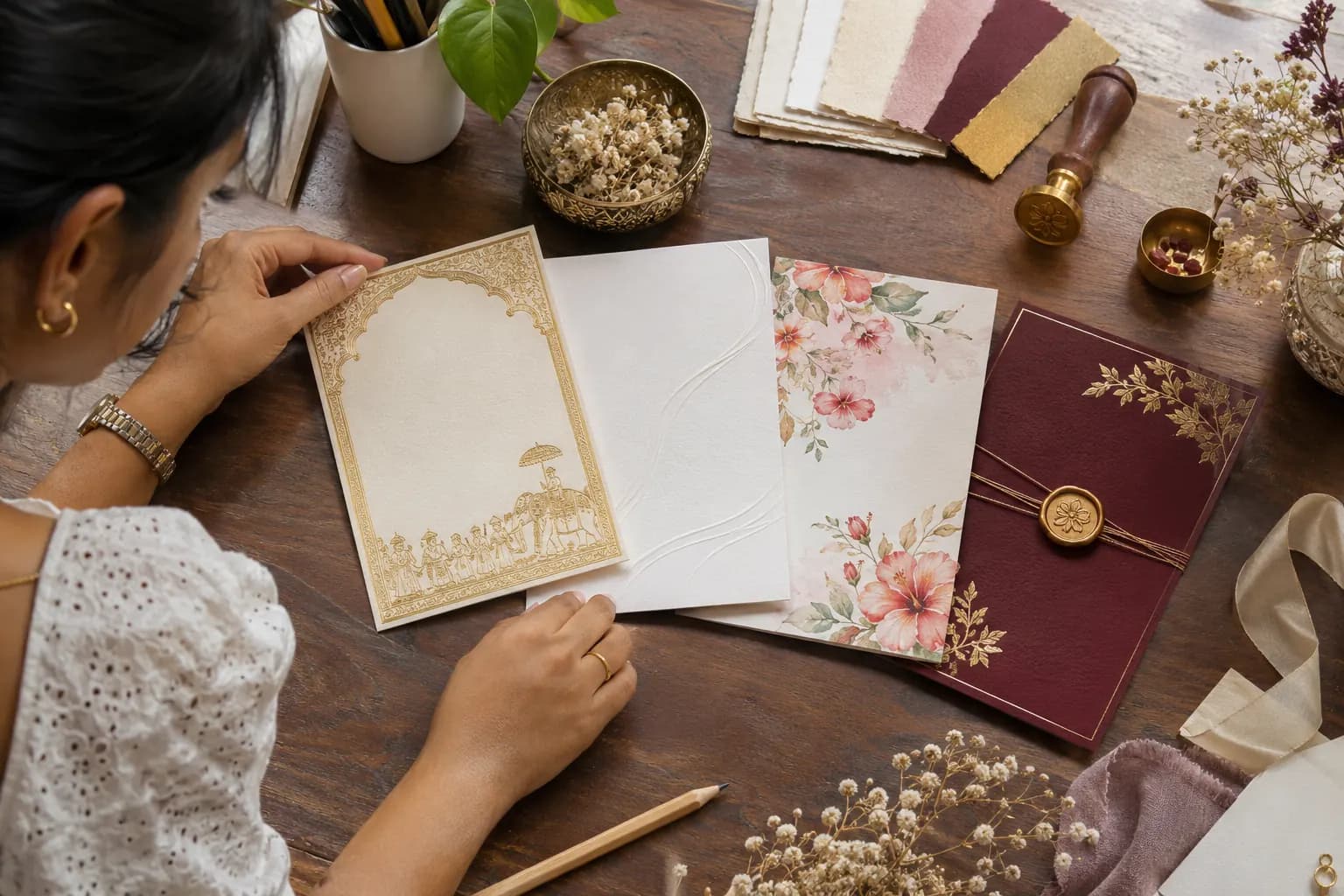
Sri Lankan wedding cards tend to fall into six families. Each has its own mood, and each sits more naturally with some ceremonies than others.
1. Traditional Kandyan
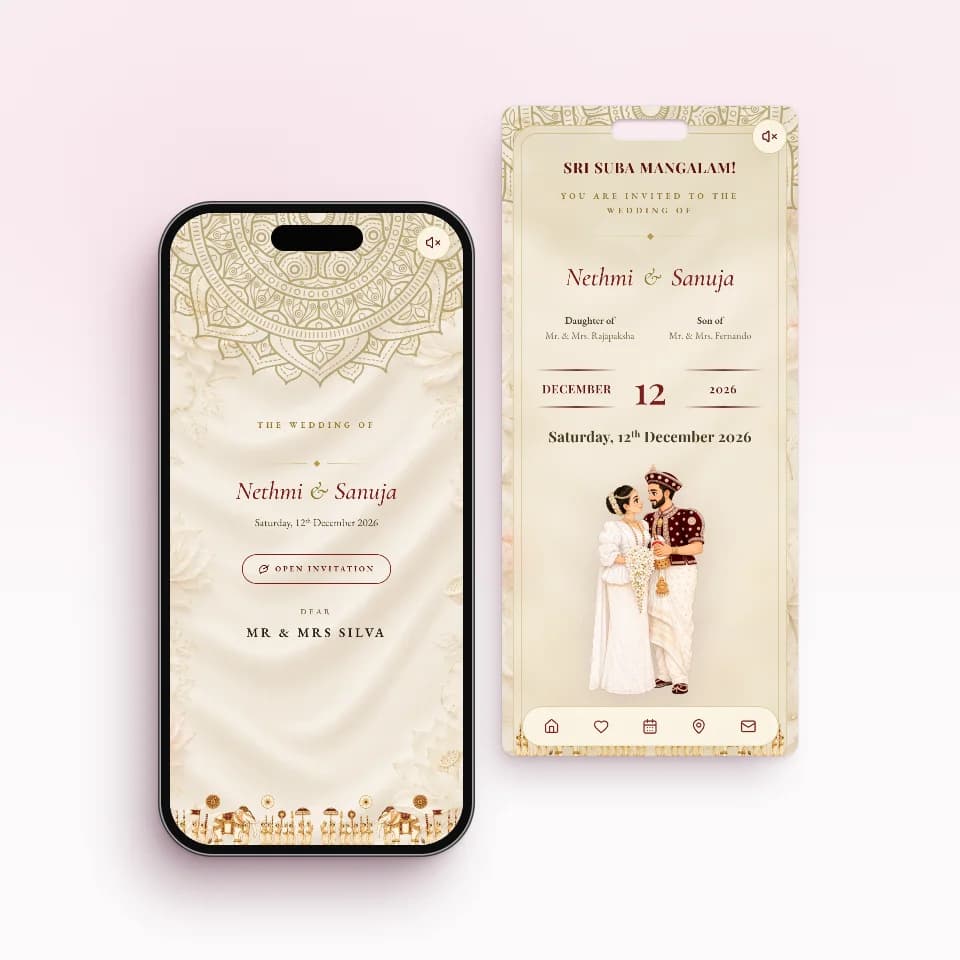
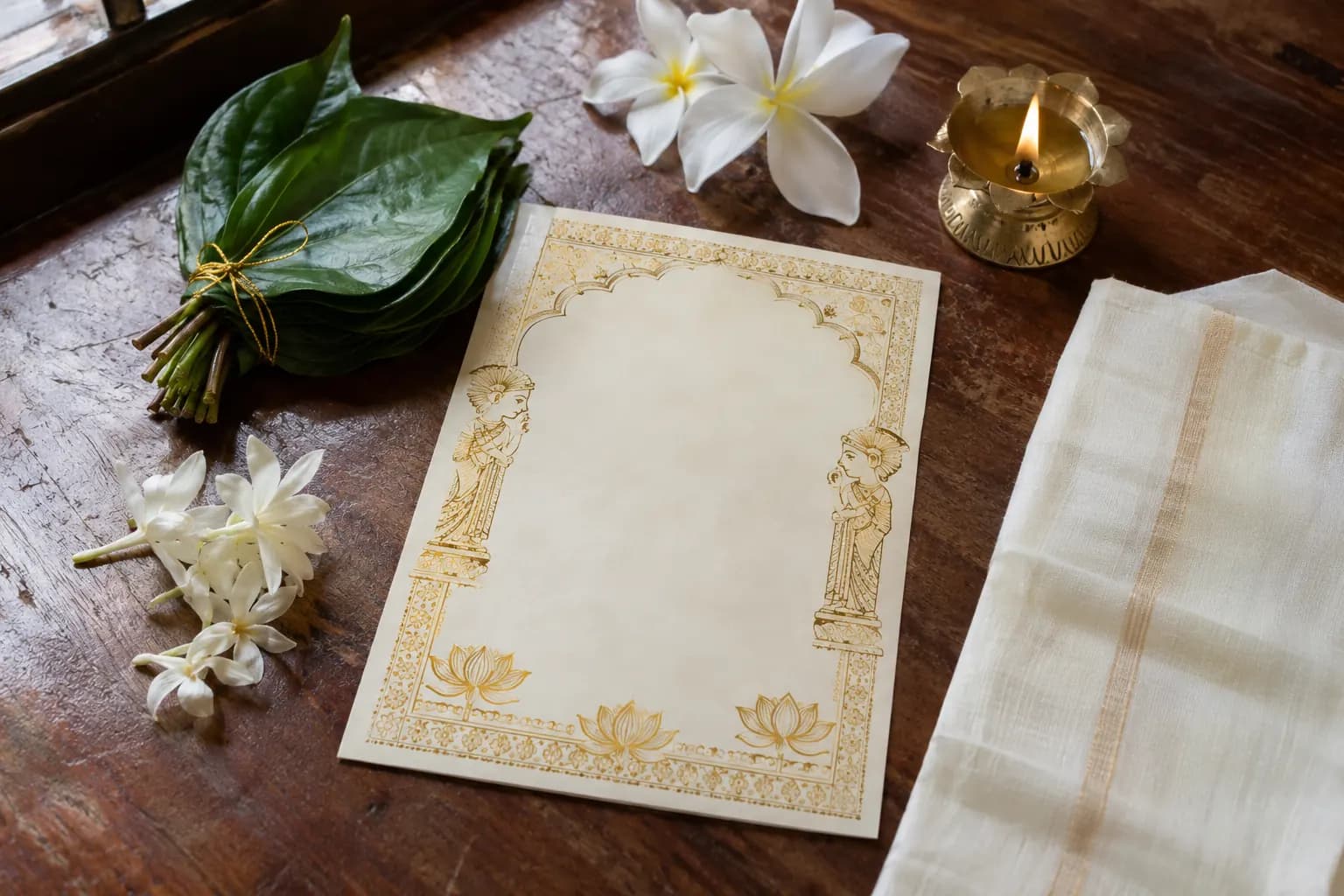
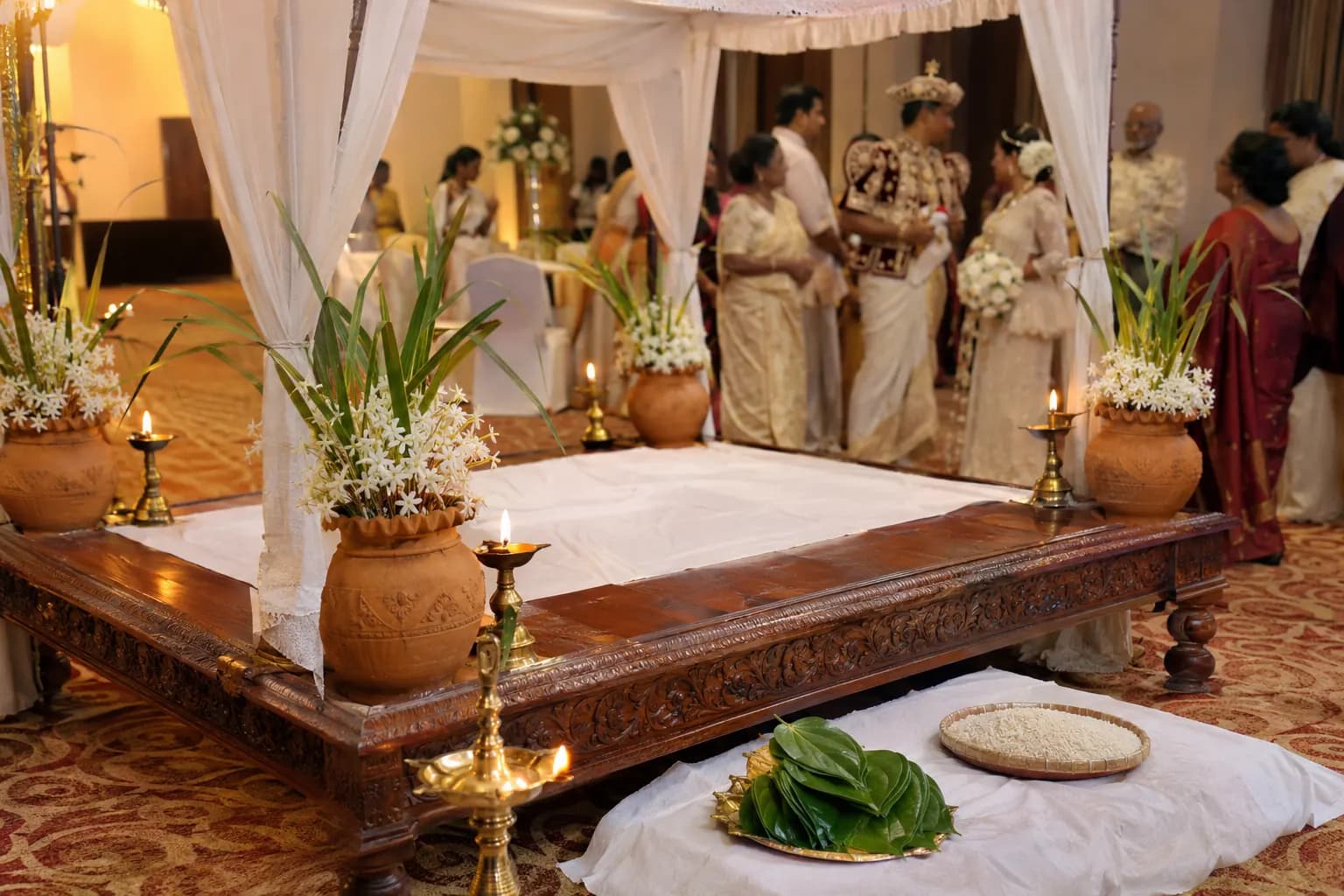
The look most families picture first: ivory or cream paper, maroon or emerald, gold borders and Kandyan detail such as the perahera, the oil lamp or the bride in her osariya. A Kandyan card usually leads with a blessing line, names both families with care and gives the Poruwa its auspicious time. It suits a Sinhala Buddhist wedding where the Poruwa is the centre of the day.
Examples to open: Nilame Traditional (Kandyan heritage in ivory and maroon) and Kandyan Classic (Kandyan emerald, with the groom in a suit). If you are planning the ceremony itself, our guide to the Poruwa ceremony explains what happens and what belongs on the invitation.
2. Modern and minimal
Plenty of white space, one strong typeface and very little ornament. Modern cards suit hotel weddings, reception-only days and couples who would rather the design step back. Online, modern designs often move: doors that open, a gate you tap, a car that drives down a palm avenue as you scroll.
Examples: Love Gate (grand doors that open on your day) and Palm Drive (a vintage car down a palm avenue).
3. Floral
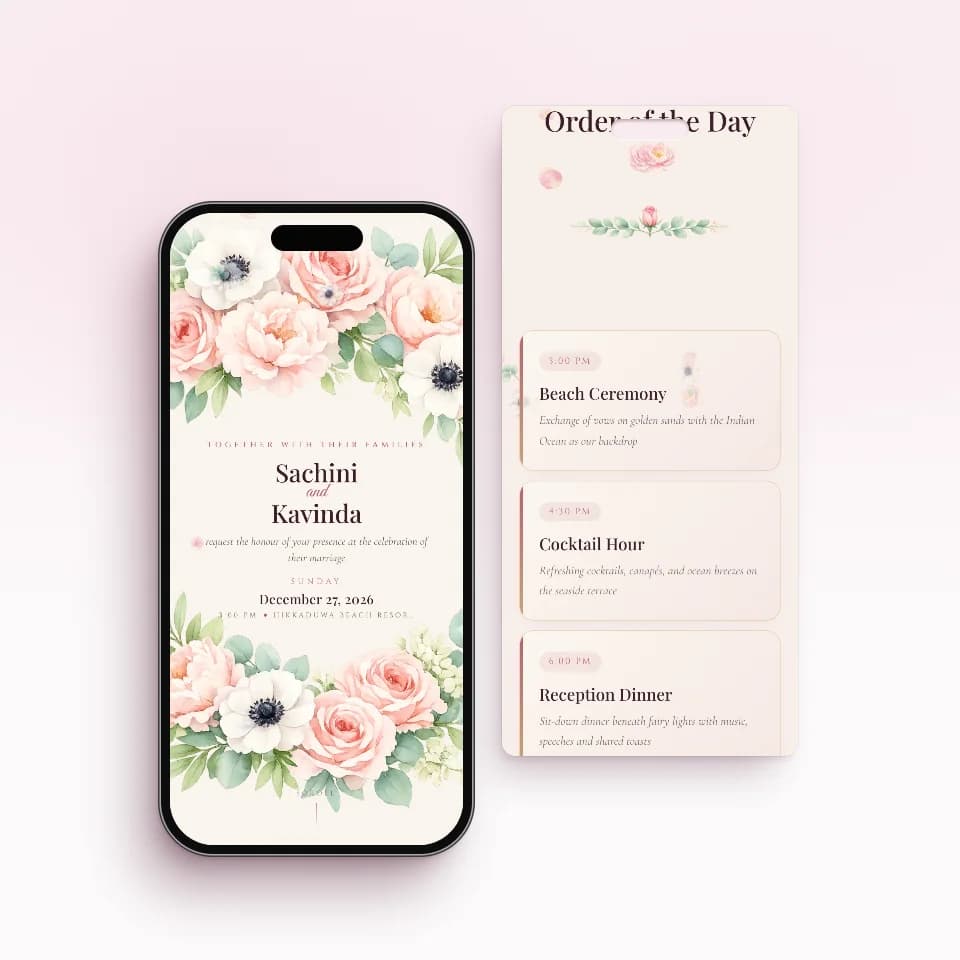
Watercolour petals, roses, hydrangeas and cherry blossoms in blush, dusty blue or soft green. Floral cards feel romantic and gentle. They are a natural fit for a church wedding or a garden reception, and they work well when one day holds both a church service and a Poruwa.
Examples: Modern Bloom (soft blush petals and watercolour) and Pink Watercolor (cherry blossoms and a wax-seal date).
4. Royal and gold
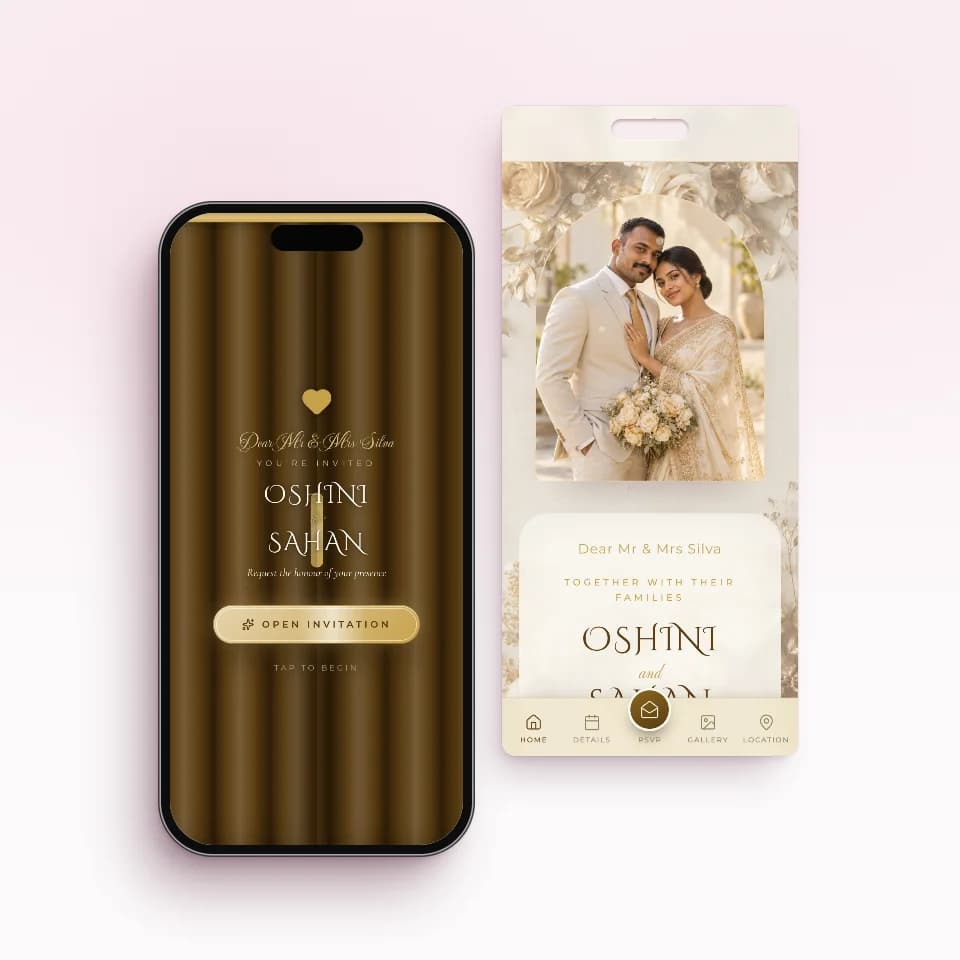
Deep burgundy, maroon or black with heavy gold: borders, filigree, gilded roses, mandalas. Gold says formal and festive, so it crosses ceremonies well. It suits a grand hotel reception, a traditional Sinhala wedding and a kovil wedding alike. The one thing to watch is contrast: gold text on a busy background is hard to read on a small screen.
Examples: Golden Seal (antique gold over gilded roses) and Ceylon Traditional (cream and gold in a Ceylon border).
5. Wax seal and envelope
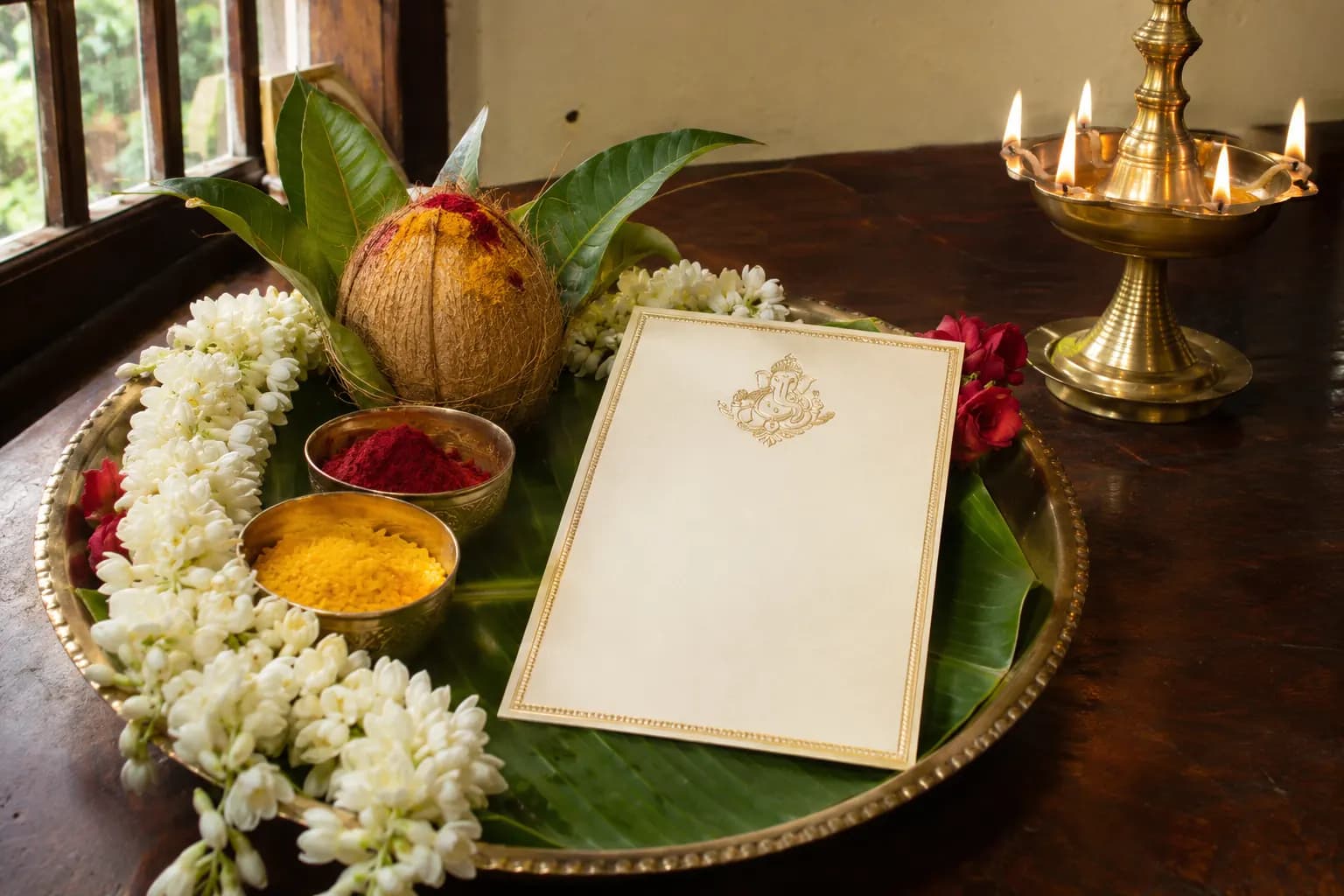
An envelope closed with a wax seal, which the guest opens to reveal the card. On paper it adds cost and a little ceremony. Online it becomes the opening moment: the guest taps the seal and the invitation unfolds. Seal designs come in almost every colour, and the style adapts to any ceremony. There are Hindu seal designs with a Ganesha seal and Nikah designs with gold arabesque.
Examples: Ivory Seal (ivory lace, pearls and an embossed seal) and Kumkum Seal (kumkum silk, temple gold and a Ganesha seal).
6. Photo-led
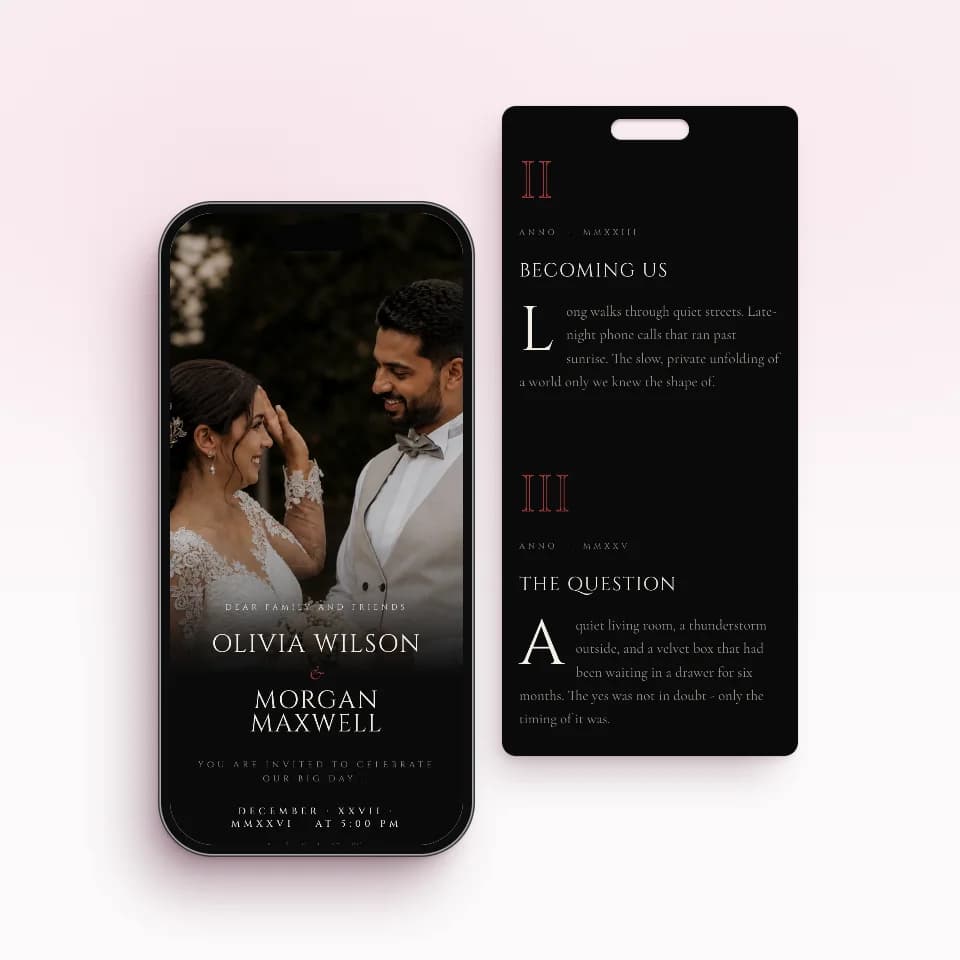
If you have a pre-shoot you love, let a photograph carry the card. A photo-led design puts one strong portrait at the top and keeps the type simple, so the picture and your names do the work. Choose a photo with calm space where the names can sit, and avoid one where faces sit in the middle of the frame.
Example: Eternal Noir (black-tie editorial with a couple portrait).
Which wedding card style suits which ceremony
This is the quick way to narrow down. Find your ceremony, then start with the styles marked as the natural fit. Nothing here is a rule: a Poruwa wedding can carry a floral card, and a church wedding can look lovely in gold.
| Style | Natural fit | Also works for | Colours to try | Watch out for |
|---|---|---|---|---|
| Traditional Kandyan | Poruwa (Sinhala Buddhist) | Homecoming, a church-and-Poruwa day | Ivory, maroon, emerald, gold | Crowding the card with ornament around the Poruwa time |
| Modern and minimal | Hotel wedding, reception only | Church, homecoming | White, black, one accent colour | Feeling too plain for elders who expect a formal card |
| Floral | Church, garden reception | Poruwa, homecoming | Blush, dusty blue, sage | Pale text on pale flowers |
| Royal and gold | Grand reception, kovil wedding | Poruwa, Nikah | Burgundy, maroon, black with gold | Gold text that is hard to read on a phone |
| Wax seal and envelope | Any ceremony | Nikah and Walima, Hindu weddings, homecoming | Ivory, emerald, blush, deep red | Hiding the date behind too many taps |
| Photo-led | Hotel or beach wedding, homecoming | Church, reception | Taken from your photo | A busy photo with nowhere to put the names |
Each ceremony also has its own page of designs: Kandyan and Poruwa invitations, church wedding invitations, Hindu and Tamil invitations and Nikah and Walima invitations.
Choosing colours for a Sri Lankan wedding card
- Start from the clothes. The bride's saree or osariya and the groom's attire set the tone of the day. A card in the same family of colours looks planned.
- Look at the venue. A hotel ballroom in gold and cream, a whitewashed church or a garden at dusk each suggest a palette.
- Pick one main colour and one accent. Maroon with gold, emerald with ivory, dusty blue with cream. A third colour is usually one too many.
- Test for contrast. Guests will usually read your card on a phone, often outdoors. Dark text on a light ground, or light text on a dark ground, reads best for older relatives.
- Keep the wedding and homecoming related. Use the same style in a different colour, for example ivory and gold for the wedding and deep red for the homecoming.
Typography: names, Sinhala and Tamil text
Good wedding card typography is mostly restraint. Use a decorative script or an engraved display face for your names, and a clear serif or sans serif for the date, times and venues. Keep times and addresses large: they are the lines guests come back to on the day.
Many Sri Lankan cards mix languages. A Sinhala card often opens with a blessing line such as ශ්රී ශුභ මංගලම් before the details, and a Tamil card may carry the heading திருமண அழைப்பிதழ் (wedding invitation). Give Sinhala and Tamil text a font made for that script, and never stretch or squash it to fit. If you write the whole card in Sinhala, read our guide to Sinhala wedding invitation cards; for Tamil, see Tamil wedding invitation cards.
What to put on a Sri Lankan wedding card
Whatever the style, a Sri Lankan wedding card carries much the same lines, roughly in this order. The example uses a made-up couple, Nimesh and Dilhani, marrying on Saturday 12 June 2027.
| Line | What it does | Example |
|---|---|---|
| Blessing or greeting | Opens the card with good wishes or a religious line | A Sinhala blessing, a Bible verse, a Tamil blessing or Bismillah |
| Both families | Says who is inviting | Mr and Mrs Perera and Mr and Mrs Silva |
| Invitation sentence | Asks the guest to attend | request the pleasure of your company at the marriage of |
| The couple | The names, given the most space | Nimesh and Dilhani |
| Date | Day, date and year in full | Saturday 12 June 2027 |
| Ceremony and time | The Poruwa auspicious time, church service or muhurtham | Poruwa ceremony at 9.15 am |
| Venue | Name and town, ideally with a map | The hotel or church, and its town |
| Reception | If it follows, or is on another day | Lunch to follow |
| RSVP | How and by when to reply | Kindly reply by 15 May 2027 |
| Optional | Dress code, contacts, a note for guests abroad | Contact numbers for each family |
For the exact words, copy a version from our Sri Lankan wedding invitation wording. If you are still waiting on the auspicious time, our article on the nakath pathraya explains how it is set.
Design mistakes to avoid
- Tiny print. A card that looks elegant on a big screen can be unreadable on a phone. Check yours at phone size before you send it.
- Too many fonts and colours. Two fonts and two colours carry almost any design.
- A missing time or venue. Read every event line once as a guest would: where, what time, and what happens next.
- Sending a squeezed picture. WhatsApp compresses images, so a photographed or exported card can blur its small print. We compared the options in a JPG card versus an invitation link.
Pick one and edit it yourself
Every design in this article is a live invitation on INVITATION.LK, and you can see them all in the full template gallery. You choose one, edit it yourself in the browser, and send it to each guest from your own WhatsApp, one tap per guest.
- Your details, your words. Add both families, every event and venue, in English, Sinhala or Tamil.
- A link for every guest. Most designs open with the guest's own name, and each guest replies Attending or Not attending with a head count.
- See who opened it. Your guest list shows who has opened their invitation and who still needs a reminder.
- Change it anytime. Fix a time or venue after sending, and guests see it on the same link.
- Free to preview. Build the whole invitation and see it on your phone before you pay.
Essential is Rs. 5,000 for one ready-made invitation, Complete is Rs. 10,000 for two (the wedding and the homecoming, for example), and Signature Custom is Rs. 20,000 for a design made just for you. You pay once, only when you publish, and every paid plan includes unlimited guest links.
Start with a design in the style you like, compare the plans and what each includes, or make a free account and start editing. If nothing feels quite right, a Signature Custom design is built from scratch around your colours and ideas.